

 Facebook
 X
X
 Pinterest
 Copy Link
What Is A Fixture In Real Estate, And How Is It Determined?


How to increase the value of your house

Curious about how to get more for your home in this market?
#4 is the most important tip.
When it’s time to sell your home, it can be overwhelming to consider what needs to be done.
Here’s the thing — there are SO many ways to improve the presentation (and value) of your home that don’t require a ton of time or money. A lot of times, some of the bigger ticket home improvements don’t even translate to a large increase in your sales price.
01 — Declutter, deep clean and depersonalize.This first recommendation requires almost no money. You want to remove any distractions so that potential buyers can easily envision their life in your home.
02 — Improve the first impressionFirst impressions matter. Spend a Saturday sprucing up your landscaping and exterior. You don’t need to break the bank here. You could repaint or touch up your front door, add flowers to your window boxes, lay fresh mulch.
03 — Create a neutral palette.If you have taste specific wall colors or wall paper, considering painting the interior of your home a neutral color. Contact me for my favorite neutral paint colors.
04 — And most importantly, consider the comps. Study other homes in your neighborhood that have recently sold. How does your home compare? Are there negatives that stand out about your home that you could easily remedy? These types of considerations can help you achieve the price you desire. Remember, every home is unique. You need someone who is an expert in your real estate market to give you a personalized recommendation for what to do to increase the value of your home. I’d be happy to provide a personalized recommendation. Contact me at (360) 420-6807.
Don’t Wait Until Spring To Sell Your House

Don’t Wait Until Spring To Sell Your House
As you think about the year ahead, one of your big goals may be moving. But, how do you know when to make your move? While spring is usually the peak homebuying season, you don’t actually need to wait until spring to sell. Here’s why.
1. Take Advantage of Lower Mortgage Rates
Last October, the 30-year fixed mortgage rates peaked at 7.79%. In January, they hit their lowest level since May. That means you may not feel as locked-in to your current mortgage rate right now. That downward trend in rates has made moving more affordable now than it was just a few months ago.
Another reason today’s rates make now a good time to sell? More buyers are jumping back into the market. Many had been waiting on the sidelines for rates to fall, but now that that’s happening, they’re eager and ready to buy. That means more demand for your house. According to Sam Khater, Chief Economist at Freddie Mac:
“Given this stabilization in rates, potential homebuyers with affordability concerns have jumped off the fence back into the market.”
2. Get Ahead of Your Competition
Right now, there are still more people looking to buy a home than there are houses for sale, which puts you in a great position. But keep in mind, with the recent uptick in new listings, we’re seeing more sellers may already be re-entering the market.
Listing your house now helps you beat your competition and makes sure your house will stand out. U.S. News explains:
“When there is low housing inventory, sellers could get top dollar for their homes.”
3. Make the Most of Rising Home Prices
Experts forecast home prices will keep going up this year. What does that mean for you? If you’re ready to sell your current house and plan to buy another one, it may be a good idea to think about moving now before prices go up more. That would give you the chance to buy your next home before it gets more expensive.
4. Leverage Your Equity
Homeowners today have tremendous amounts of equity. In fact, a recent report from CoreLogic says the average homeowner with a mortgage has more than $300,000 in equity.
If you’ve been waiting to sell because you were worried about home affordability, know your equity can really help with your next move. It might even cover a big part, or maybe all, of the down payment for your next home.
Bottom Line
If you’re thinking about selling your house and moving to another one, let’s connect to get the process started now so you can get a leg up on your competition.
The Secret to Getting the Most Offers

 Ready to spark a bidding war? Let’s make it happen! If you’re looking to sell your home in the Skagit Valley, it would be my honor to guide you through the process.
2 of the Factors That Impact Mortgage Rates

2 of the Factors That Impact Mortgage Rates

If you’re looking to buy a home, you’ve probably been paying close attention to mortgage rates. Over the last couple of years, they hit record lows, rose dramatically, and are now dropping back down a bit. Ever wonder why?
The answer is complicated because there’s a lot that can influence mortgage rates. Here are just a few of the most impactful factors at play.
Inflation and the Federal Reserve
The Federal Reserve (Fed) doesn’t directly determine mortgage rates. But the Fed does move the Federal Funds Rate up or down in response to what’s happening with inflation, the economy, employment rates, and more. As that happens, mortgage rates tend to respond. Business Insider explains:
“The Federal Reserve slows inflation by raising the federal funds rate, which can indirectly impact mortgages. High inflation and investor expectations of more Fed rate hikes can push mortgage rates up. If investors believe the Fed may cut rates and inflation is decelerating, mortgage rates will typically trend down.”
Over the last couple of years, the Fed raised the Federal Fund Rate to try to fight inflation and, as that happened, mortgage rates jumped up, too. Fortunately, the expert outlook for inflation and mortgage rates is that both should become more favorable over the course of the year. As Danielle Hale, Chief Economist at Realtor.com, says:
“[M]ortgage rates will continue to ease in 2024 as inflation improves . . .”
There’s even talk the Fed may actually cut the Fed Funds Rate this year because inflation is cooling, even though it’s not yet back to their ideal target.
The 10-Year Treasury Yield
Additionally, mortgage companies look at the 10-Year Treasury Yield to decide how much interest to charge on home loans. If the yield goes up, mortgage rates usually go up, too. The opposite is also true. According to Investopedia:
“One frequently used government bond benchmark to which mortgage lenders often peg their interest rates is the 10-year Treasury bond yield.”
Historically, the spread between the 10-Year Treasury Yield and the 30-year fixed mortgage rate has been fairly consistent, but that’s not the case recently. That means, there’s room for mortgage rates to come down. So, keeping an eye on which way the treasury yield is trending can give experts an idea of where mortgage rates may head next.
To navigate any mortgage rate changes and their impact on your moving plans, it’s best to have a team of professionals on your side which is why I work with a trusted team of local service providers to help you navigate the real estate market.
Helpful Tips When Moving

When providing tips to my clients, I feel it is important to offer advice that can help streamline the process and make the transition smoother. Here are some of my best tips:
1️⃣ Plan ahead to avoid last minute stress. I provide my buyers with a timeline and checklist to stay organized.
2️⃣ Declutter before packing to reduce the amount of stuff you have to move and unpack.
3️⃣ Pack efficiently using sturdy boxes and packing materials to protect your belongings. It is helpful to pack rooms room by room and label each box with its contents and destination room.
4️⃣ Hire Professional Movers. It can be very helpful to hire a professional movers for heavy or valuable items. In my listing packet, I provide multiple moving companies where you can get quotes, read reviews and choose the one best for you.
5️⃣ Update your information with the postal service, banks, utilities, and other important institutions.
6️⃣ Utilities & Services: when moving, you want to arrange for the disconnection of utilities at your old home, and the connection at your new one, whereas you can transfer or set up services like internet, cable and gas.
7️⃣ Pack essentials separately so that you have a few things you need for the first day in a new home.
8️⃣ Take inventory of your belongings which can be useful for insurance purposes and to ensure nothing gets lost during the move.
9️⃣ Furniture placement plan: this one can be a tricky one and if you’re like me, you end up moving things around once you get settled in however, if you have a layout of furniture before moving day it can help save time while unpacking.
🔟 Secure valuable items (important papers, jewelry) during your move for added security.
1️⃣1️⃣ Take photos before disassembling, electronics, or furniture to remember how they were set up.
1️⃣2️⃣ Have a cleaning kit ready for both your old home and new home and clean as you go to make a final move out easier.
Obviously every move is unique, so feel free to adapt these tips based on your knees and circumstances.
3 Must-Do’s When Selling Your House in 2024

3 Must-Do’s When Selling Your House in 2024

If one of the goals on your list is selling your house and making a move this year, you’re likely juggling a mix of excitement about what’s ahead and feeling a little sentimental about your current home.
A great way to balance those emotions and make sure you’re confident in your decision is to keep these three best practices in mind when you’re ready to sell.
1. Price Your Home Right
The housing market shifted in 2023 as mortgage rates rose and home price appreciation started to normalize once again. As a seller, you still need to recognize how important it is to price your house appropriately based on where the market is today. Hannah Jones, Economic Research Analyst for Realtor.com, explains:
“Sellers need to become familiar with their local market and work closely with a local agent to make sure their listing is attractive to buyers. Buyers feeling the pressure of affordability are likely to be pickier, so a well-priced, well-maintained home is the ticket to drumming up big demand.”
If you price your house too high, you run the risk of deterring buyers. And if you go too low, you’re leaving money on the table.
2. Keep Your Emotions in Check
Today, homeowners are staying in their houses longer than they used to. According to the National Association of Realtors (NAR), since 1985, the average time a homeowner has owned their home has increased from 6 to 10 years (see graph below):
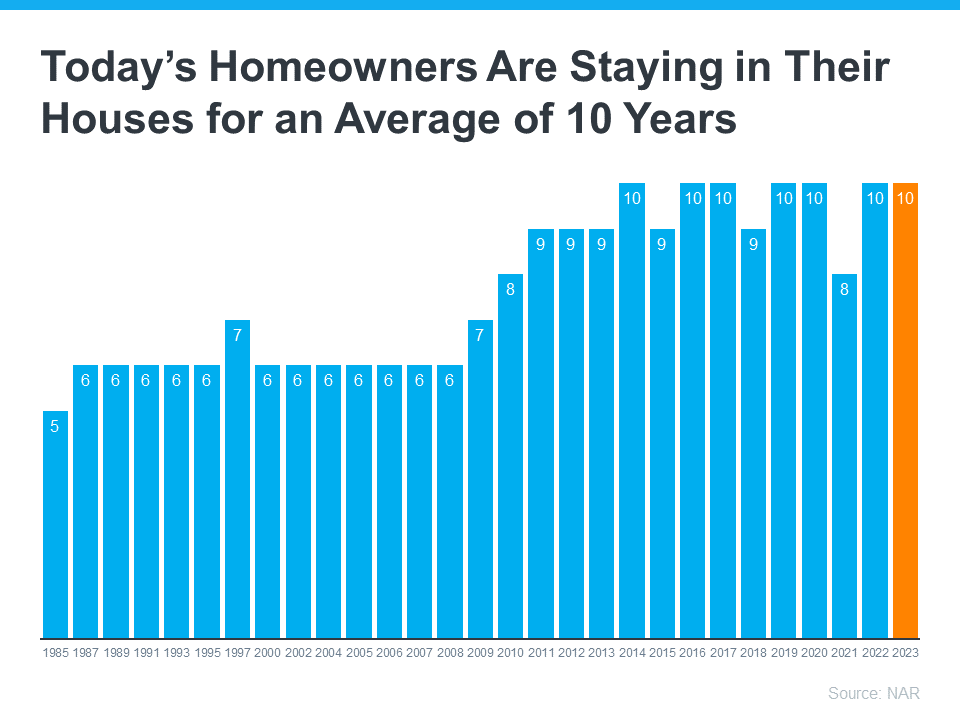
This is much more than what used to be the norm. The side effect, however, is when you stay in one place for so long, you may get even more emotionally attached to your space. If it’s the first home you bought or the house where your loved ones grew up, it very likely means something extra special to you. Every room has memories, and it’s hard to detach from the sentimental value.
For some homeowners, that makes it even tougher to separate the emotional value of the house from fair market price.
3. Stage Your Home Properly
While you may love your decor and how you’ve customized your house over the years, not all buyers will feel the same way about your vibe. That’s why it’s so important to make sure you focus on your home’s first impression, so it appeals to as many buyers as possible.
Buyers want to be able to picture themselves in the home. They need to see themselves inside with their furniture and keepsakes – not your pictures and decorations. As Jessica Lautz, Deputy Chief Economist and Vice President of Research at NAR, says:
“Buyers want to easily envision themselves within a new home and home staging is a way to showcase the property in its best light.”
If you’re considering selling your house, let’s connect so you have help navigating the process while prioritizing these must-do’s.
Unlocking the Secrets of your Dream Home

The Dramatic Impact of Homeownership on Net Worth

The Dramatic Impact of Homeownership on Net Worth
If you’re trying to decide whether to rent or buy a home this year, here’s a powerful insight that could give you the clarity and confidence you need to make your decision.
Every three years, the Federal Reserve releases the Survey of Consumer Finances (SCF), which compares net worth for homeowners and renters. The latest report shows the average homeowner’s net worth is almost 40X greater than a renter’s (see graph below):
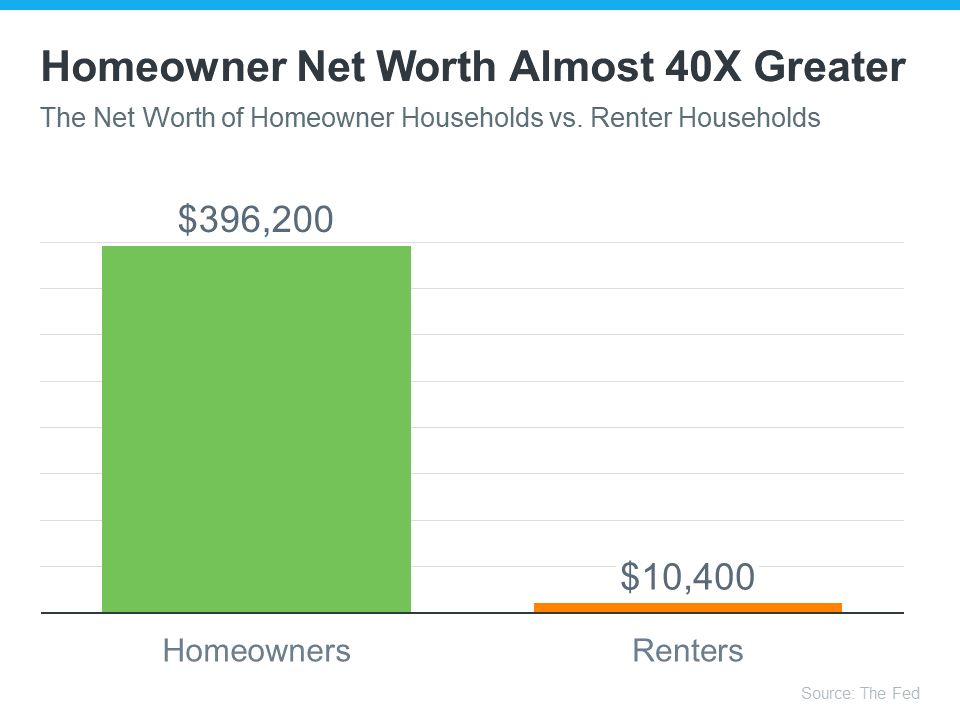
One reason a wealth gap exists between renters and homeowners is because when you’re a homeowner, your equity grows as your home appreciates in value and you make your mortgage payment each month. When you own a home, your monthly mortgage payment acts like a form of forced savings, which eventually pays off when you decide to sell. As a renter, you’ll never see a financial return on the money you pay out in rent every month. Ksenia Potapov, Economist at First American, explains it like this:
“Renters don’t capture the wealth generated by house price appreciation, nor do they benefit from the equity gains generated by monthly mortgage payments . . .”
The Largest Part of Most Homeowner Net Worth Is Their Equity
Home equity does more to build the average household’s wealth than anything else. According to data from First American and the Federal Reserve, this holds true across different income levels (see graph below):
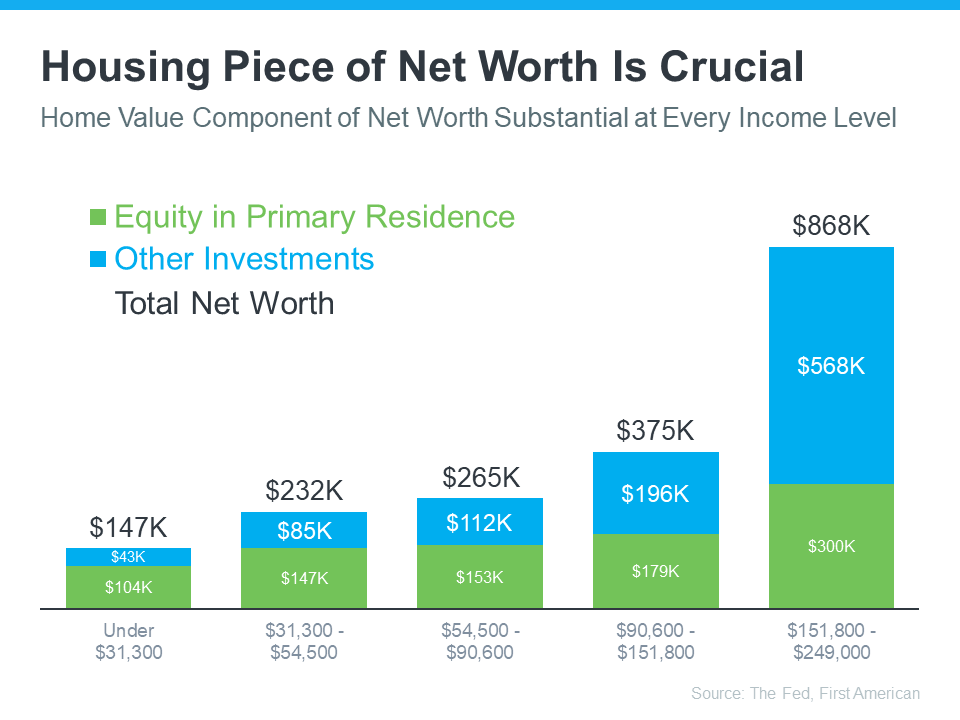
The green segment in each bar represents how much of a homeowner’s net worth comes from their home equity. Based on this data, it’s clear no matter what your income level is, owning a home can really boost your wealth. Nicole Bachaud, Senior Economist at Zillow, shares:
“The biggest asset most people are ever going to own is a home. Homeownership is really that financial key that helps unlock stability and wealth preservation across generations.”
If you’re ready to start building your net worth, the current real estate market offers several opportunities you should consider. For example, with mortgage rates trending lower lately, your purchasing power may be higher now than it has been in months. And, with more inventory coming to the market, there are more options for you to consider.
Bottom Line
If you’re unsure about whether to rent or buy a home, keep in mind that owning a home can increase your overall wealth in the long run, no matter your income. To discover more about this and the many other benefits of homeownership, let’s connect.
Thinking About Buying a Home? Ask Yourself These Questions

Thinking About Buying a Home? Ask Yourself These Questions
If you’re thinking of buying a home this year, you’re probably paying closer attention than normal to the housing market. And you’re getting your information from a variety of channels: the news, social media, your real estate agent, conversations with friends and loved ones, the list goes on and on. Most likely, home prices and mortgage rates are coming up a lot.
Here are the top two questions you need to ask yourself as you make your decision, including the data that helps cut through the noise.
1. Where Do I Think Home Prices Are Heading?
One reliable place you can turn to for information on home price forecasts is the Home Price Expectations Survey from Fannie Mae – a survey of over one hundred economists, real estate experts, and investment and market strategists.
According to the most recent release, the experts are projecting home prices will continue to rise at least through 2028 (see the graph below):
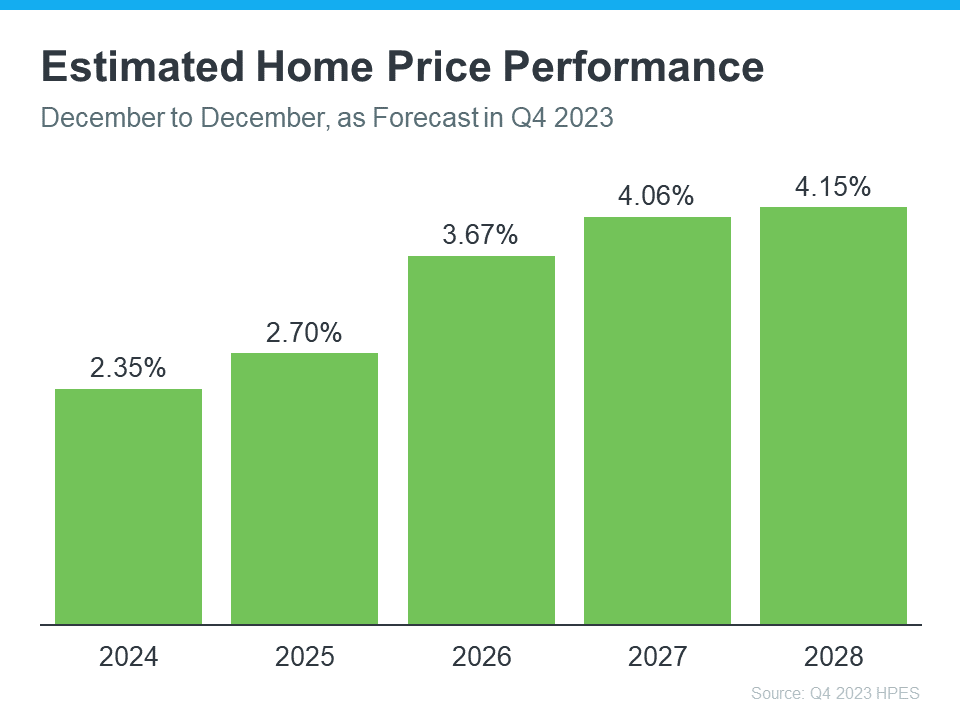
So, why does this matter to you? While the percent of appreciation may not be as high as it was in recent years, what’s important to focus on is that this survey says we’ll see prices rise, not fall, for at least the next 5 years.
And home prices rising, even at a more moderate pace, is good news not just for the market, but for you too. It means, by buying now, your home will likely grow in value, and you should gain home equity in the years ahead. But, if you wait, based on these forecasts, the home will only cost you more later on.
2. Where Do I Think Mortgage Rates Are Heading?
Over the past year, mortgage rates spiked up in response to economic uncertainty, inflation, and more. But there’s an encouraging sign for the market and mortgage rates. Inflation is moderating, and here’s why this is such a big deal if you’re looking to buy a home.
When inflation cools, mortgage rates generally fall in response. That’s exactly what we’ve seen in recent weeks. And, now that the Federal Reserve has signaled they’re pausing their Federal Funds Rate increases and may even cut rates in 2024, experts are even more confident we’ll see mortgage rates come down.
Danielle Hale, Chief Economist at Realtor.com, explains:
“. . . mortgage rates will continue to ease in 2024 as inflation improves and Fed rate cuts get closer. . . . a key factor in starting to provide affordability relief to homebuyers.”
As an article from the National Association of Realtors (NAR) says:
“Mortgage rates likely have peaked and are now falling from their recent high of nearly 8%. . . . This likely will improve housing affordability and entice more home buyers to return to the market . . .”
No one can say with absolute certainty where mortgage rates will go from here. But the recent decline and the latest decision from the Federal Reserve to stop their rate increases, signals there’s hope on the horizon. While we may see some volatility here and there, affordability should improve as rates continue to ease.
If you’re thinking about buying a home, you need to know what’s expected with home prices and mortgage rates. While no one can say for certain where they’ll go, making sure you have the latest information can help you make an informed decision. Let’s connect so you can stay up to date on what’s happening and why this is such good news for you.
