

 Facebook
 X
X
 Pinterest
 Copy Link
Market Check: Skagit County January 2026
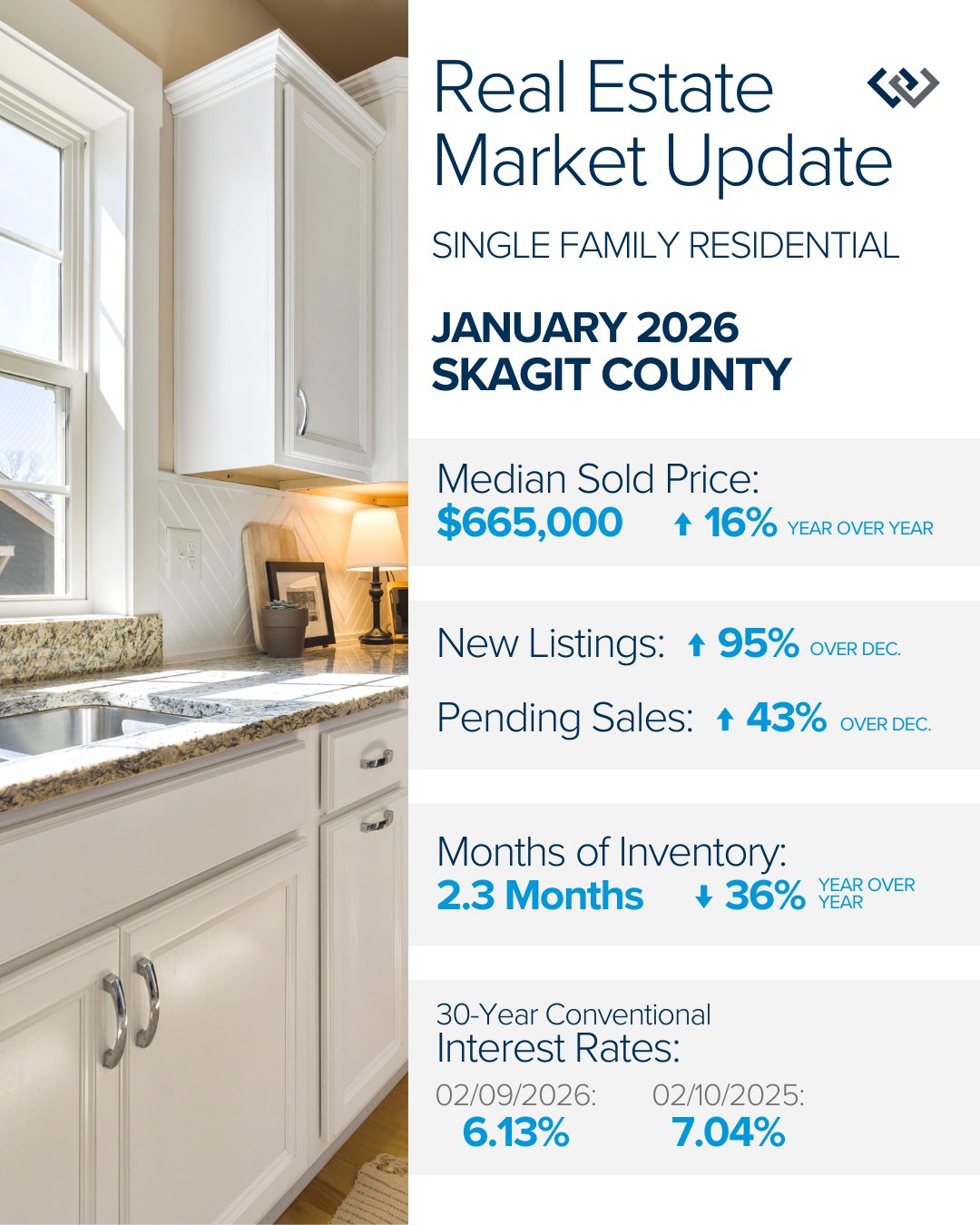
📊 January Market Snapshot | Skagit County
The year is starting with momentum.
✔️ Median price: $665,000 (⬆️ 16% year over year)
✔️ New listings up 95% over December
✔️ Pending sales up 43% over December
✔️ Inventory at just 2.3 months
And here’s what really matters ➡️ interest rates are lower than this time last year (6.13% vs 7.04%).
What does this mean?
Buyers: More options are coming online, and rates are improving, but inventory is still tight. Strong homes are moving.
Sellers: Demand is active and prices are holding. Strategic pricing still matters.
January is often a signal month for the rest of the year… and this one is telling us the market is awake.
If you want to know what this means for your neighborhood or price point, message me.
The North Cascades

Wild Beauty Meets Endless Wonder in the North Cascades. If you have ever taken Highway 20 or stood at a lookout along the North Cascades Scenic Byway, you have experienced the difference. It is more dramatic, raw, and rugged than just about anywhere else in Washington. What makes The North Cascades so different? They aren’t just mountains! They are one of the most spectacular landscapes in North America. The product of being carved by ice, shaped by time, and wrapped in a sense of wildness that is difficult to describe but impossible to forget once experienced.
Welcome to the North Cascades: the “American Alps” that live up to their name in every way.
A Landscape Carved by Time and Ice
The North Cascades are some of the most rugged mountains in the continental United States. There’s a reason for that! For millions of years, glaciers have scraped, sculpted, and carved this region into sharp ridgelines, jagged peaks, plunging valleys, and steep-walled canyons.
It’s this geologic history that gives the range its dramatic appearance:
- Craggy peaks that cut into the sky
- Deep turquoise lakes fed by glacial runoff, like Diablo Lake
- U-shaped valleys formed by massive sheets of ice
- Waterfalls that appear to tumble from nowhere
Counts cite over 300 glaciers! For reference, North Cascade glaciers make up nearly a third of all glaciers found in the lower 48 states. By far, the largest collection in the Lower 48. These glaciers continue shaping the landscape today, leaving behind the striking blues and rocky textures the North Cascades are known for.
A Wilderness of Pines, Snow, and Untamed Beauty
The North Cascades are home to dense forests of cedar, fir, and pine that cling to the slopes and fill the valleys below. As you approach the higher elevations, the trees give way to wildflower meadows, windswept ridges, and snowy peaks that remain frosted long into summer.
It is here; you find:
- Towering evergreens that fill the air with the scent of resin and rain
- Snowfields and glaciers that glow blue in the afternoon light
- Wildlife like black bears, marmots, mountain goats, and soaring eagles
- Alpine lakes so clear that they reflect the peaks like glass
The North Cascades are remote enough to feel untouched, yet accessible enough that anyone can experience moments that feel like pure wilderness escape.
The North Cascades Highway: A Drive Like No Other
If there is one thing that elevates this mountain range even further, it’s the drive.
Highway 20 (the North Cascades Scenic Byway) is often called one of the most beautiful drives in the country. For good reason, every switchback and overlook reveals something new:
- The emerald waters of Diablo Lake
- The towering spires of Liberty Bell Mountain
- The vast, layered ridgelines stretching endlessly into the horizon
- Rivers, forests, and valleys that change color with every season
Whether you are stopping at lookouts, hiking a trail, or simply soaking in the view from your car window, the drive offers a sense of awe that builds mile after mile.
Fall lights up in fiery colors of oranges and golds. Winter wraps the peaks in white. Spring returns with roaring waterfalls, and summer unveils the full glory of alpine blue skies. No matter when you visit, the North Cascades feel like a new place every time.
What Makes the North Cascades So Special?
It’s a combination of drama, solitude, and sheer natural beauty. It is the feeling of seeing mountain after mountain fade into the distance, knowing most of them are untouched wilderness. It’s the sense that the land is old, powerful, and yet still shaping itself.
The North Cascades are special because they remind us of something rare:
There are still places where nature feels truly wild.
Thinking about calling the PNW home? Let’s Connect!
February in the Skagit Valley

And just like that… hello February 💕
The shortest month of the year, but packed with ALL the cozy vibes, sweet treats, and local fun here in Skagit County.

From Valentine’s dinners (book early) to community happenings, I’ve rounded up some favorite ways to love local this month. 💌

Share this blog with your favorite date night buddy or adventure partner below! Hope to see you out and about around town. 😊
Your Skagit County Realtor, sharing local favorites + all things home. 🤍
Home Updates That Actually Pay You Back When You Sell

Planning to sell this spring? While you may be tempted to hold off until the first blooms or the spring showers hit, that’s actually waiting too long to get started by today’s standards.
Buyers have more options than they did a few years ago. So, it’s worth it to tackle repairs now and make sure your house is set up to stand out. Because you don’t want to be caught scrambling right before the spring rush. Or, running out of time to do the work your house really needs.
The key is focusing on updates that actually matter. And that’s exactly where return-on-investment (ROI) data comes in handy.
Which Projects Tend to Pay Off?
Every year, Zonda looks at which home improvements deliver the most bang for the buck when you go to sell the home. And the results can be a little surprising.
The green in the chart below shows the updates where sellers have the biggest potential to add value based on that research:
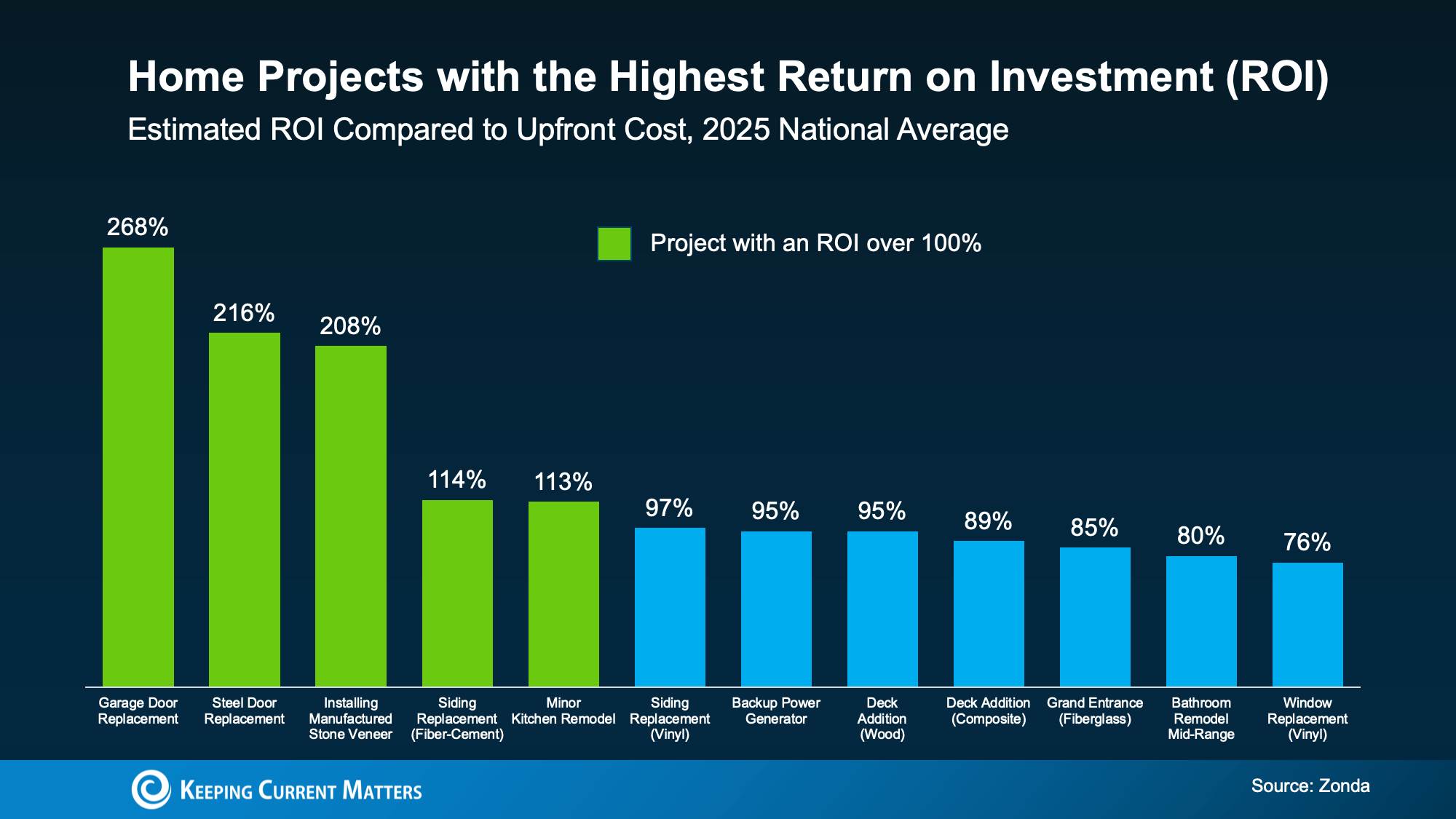
While there’s a wide range of projects represented in this data, the cool part is, some of the top winners aren’t big to-do’s. They’re just swapping out doors.
Small Updates, Big Visual Impact
This goes to show little projects can have a big impact. So, you don’t have to spend a fortune. And you don’t need to tackle everything on this list. But in today’s market, doing nothing can work against you.
Now that buyers have more homes to choose from, a lot of them are going to opt for what’s move-in ready.
The best advice? Focus on what your house needs, whether it’s listed here or not – like the repairs you’ve been putting off. A front door or shutters in need of a little TLC. Piles of leaves in the yard. Scuffed up paint where your kids play inside. Those details matter too.
Mallory Slesser, Interior designer and Home Stager, explains it to the National Association of Realtors (NAR) this way:
“If you’re looking for affordable updates that pack a punch, dollar for dollar, I would say painting; changing out light fixtures; changing out hardware; maybe new draperies or window treatments. Those are all cost-effective ways to make a big statement. It really changes the space.”
These seemingly small things help buyers focus on the home itself – not the work they think they’ll have to do after moving in. And that’s paying off for other sellers. Buyers are often willing to spend more on homes that feel well cared for, updated, and move-in ready.
Here’s the important thing to remember. National data like this is a guideline. Buyer preferences are going to vary by location, price point, and even neighborhood. That means a project that boosts value in one area might be unnecessary (or even overkill) in yours. I’m Danielle Martin, and I help clients understand which investments deliver the strongest ROI in the North Sound and throughout the Pacific Northwest
Affordability Strategies – House Hacking Tips to Help Overcome Monthly Payment Barriers
While we are seeing the market show signs of improvement and uptick in activity in Q4 2025, the biggest challenge we see in the real estate market is affordability. Prices in our area have remained stable after many years of appreciation, and interest rates, while improving, are hovering around 6.25%. This combination has monthly payments expensive, especially for first-time buyers and buyers on fixed incomes, such as retirees, seniors, or people looking to retire and fix their overhead.

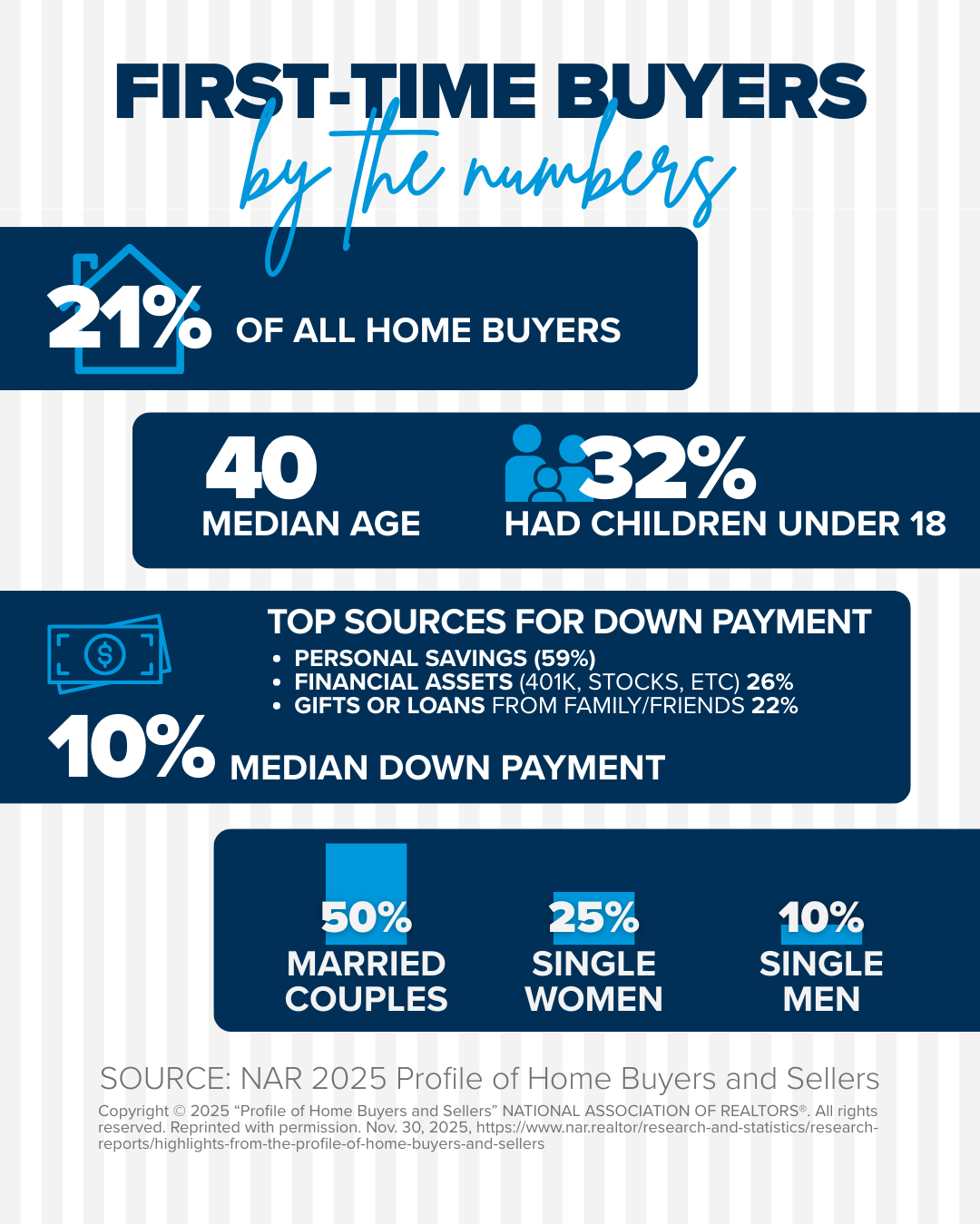
In fact, the latest Profile of Homes Buyers and Sellers by the National Association of Realtor (NAR) shows that the rate of first-time buyers is at an all-time low, accounting for only 21% of all buyers. The median age for this group increased to age 40, the highest ever. This illustrates that affordability is putting pressure on this group and delaying their start to building long-term household wealth. The average net worth of a renter versus a homeowner is staggering, so this is an important obstacle to overcome for those who have the resources but find themselves on the bubble of this decision.
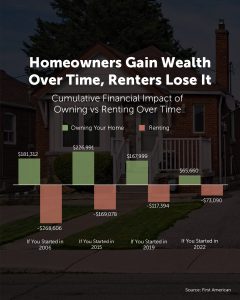
I have helped buyers overcome affordability challenges by applying some creative house hacking strategies. These are powerful tools, as they can empower a person to become a homeowner instead of renting, putting them on the path to building household wealth much faster. Plus, Greater Seattle Area rents are costly, so if one can find a way to pay their own mortgage instead of their landlord’s, they will start to build a nest egg of security for their own future.
A common myth we see is that buyers think they need 20% down to buy a home. That is simply not true, according to NAR, the average down payment for a first-time buyer was 10%. While a 20% down payment can eliminate mortgage insurance, there are loan programs such as FHA and some Conventional programs that only require 3-5% down. There are also down payment assistance programs that are available that result in 0% down, and VA financing can be as low as 0% as well.
Speaking of down payments, I see buyers diversify by utilizing or borrowing against stocks and/or 401K funds, and the NAR survey revealed 26% of first-time buyers used these types of funds to achieve their homeownership goals. It is also not uncommon for some fortunate buyers to receive gift funds in order to achieve homeownership, and the NAR survey showed 22% of first-time buyers were able to utilize this route. With the big picture of building household wealth in mind and the fact that everyone needs a roof over their head, having your home be a part of your investment portfolio makes sense.
House Hacking Tips for First-Time Buyers
The “Live in One, Rent the Rest” Starter Play
Shop 2–4 unit properties (duplex/triplex/fourplex). When you buy a multi-unit property and live in one unit, you get to enjoy owner-occupied financing rates. You can live in one of the units and rent the other(s) to help offset your mortgage payment. This could even allow for a lower down payment. It is important to calculate your potential monthly payment and assess rental rates in the area to figure out how having a renter(s) would help offset your monthly overhead. Also, consider if you had a vacancy, could you still make it work while you tried to fill it.

If the numbers work for your monthly cash flow, this is an excellent way to obtain homeownership. Down the road, you are building equity while someone else helps pay down your mortgage. Further, if you wanted to eventually move on to another property, you could sell this and reap the equity for a larger down payment or keep the property (at the owner-occupied financing rate) and rent all the units.
ADU Options
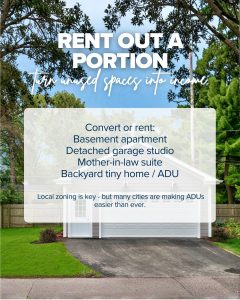
Seattle allows up to two ADUs per lot, and no owner-occupancy requirement (you don’t have to live there forever to keep it legal). Parking requirements are relaxed, too. Outside of Seattle these zoning requirements vary, but this is a rising trend.
You could buy a home with an existing ADU (detached cottage, basement unit, garage studio). Or buy an “ADU-ready”: daylight basement + exterior door, or garage with alley access. Start by renting a room or partial suite now, then add/finish an ADU later when cash allows.
Rent-by-the-Room to Offset Overhead
One roommate can take the edge off your payment; two roommates can be a full-on subsidy. When shopping for a home, prioritize layouts that naturally separate space (split-levels, basements, mother-in-law setups). I’ve seen some buyers already know who their roommate will be, so they can shop with confidence and also be comfortable with their living situation.
Purchase with a Trusted Partner with Similar Housing Goals.
Pooling funds for a down payment and sharing the monthly overhead is a great way to obtain homeownership with a trusted partner. This could be a close friend, family member, or domestic partner. You would ideally need to commit to at least 3-5 years of sharing the mortgage to build equity and avoid selling too early, and having a written agreement outlining the exit strategy is key. Based on average annual appreciation rates, 3-5 years would offset any selling costs and provide equity growth outside of something catastrophic happening in the market. This is a great way to protect your savings, build wealth as a team, and not throw money away on rent.

I knew two young women who pooled their savings to buy a home, and they also placed a roommate in a basement bedroom to help offset the mortgage. They later sold that house when they both got engaged and were able to buy great long-term homes with their partners using the equity they built. This partnered approach on their first home put them on the path to stability, security, and flexibility for their futures.
Buy a Cosmetic Fixer
Many buyers prefer homes that are “done” and fully updated. Those homes often come at a premium because they have a larger buyer audience. If you are willing to live with dated finishes or an unfinished space, you have the opportunity to build sweat equity with improvements you can make down the road when you can afford to.
It is important that you look for a home that’s structurally sound, as those can be expensive items to remedy, such as electrical, plumbing, roof, etc. Hiring a trusted inspector to perform proper due diligence is an important step. A dated kitchen or bathroom is a livable situation, and these homes build equity over time, too. If a home has an unfinished basement, there is an amazing opportunity to finish that space in the future and gain a higher value. Plus, you could rent this finished space to help offset the expense.
Buy a Fixer
There are renovation loans available, such as an FHA 203(k), that can be used to do more extensive repairs, additions, and updates. These loans provide funds to make improvements after closing. They are very detailed loan programs that require further scrutiny on value through appraisal and contractor bids, but can be successful in bringing a broken-down home to a livable structure and on the path to building equity. You have to be hearty and resourceful for these projects, so heed caution when considering this option. I have a great list of vendors and contractors that can help.
Most importantly, you must consider the Triangle of Buyer Clarity when shopping. Whether you are house hacking or just buying your first home without any of these creative solutions, being realistic about what you can afford is paramount. The relationship between location, price, and features/condition matters! Buyers must be flexible with their wants and understand that in reality, they typically get 70-75% of what’s on their wish list. Such as buying a townhome instead of a single-family home, settling on a location a little further away, or choosing a home that is not perfectly updated. However, they get a house and an opportunity to build wealth! This wealth-building game is a step-by-step process with every home a stepping stone over time.

As you can see, this triangle is not a perfectly balanced triangle, some sides are adjusted more than others. A buyer may have to reduce the number of features they would like in order to obtain the price and/or location they desire. This gets them on the path of equity growth, though, so compromise and flexibility are key! You need to get clear on your goals and adjust the triangle to make it work.
If you are curious about how these house hacking tips can help you or someone you know, or you’re just curious about the market, please reach out. It is always my goal to help keep you informed in order to empower strong decisions.
Holiday Events in the Skagit Valley

If you’re looking for the perfect spot to grab photos with Santa this season, here are some of the best options happening around Skagit County – from cozy indoor setups to festive outdoor events, pet-friendly photo ops, and even appearances from Mrs. Claus!
📸 Santa Photos at Skagit Acres
Fridays–Sundays, Nov 14–Dec 21 | Mount Vernon
Professional photos with Santa! Kids, families & pups welcome. Includes 4 digital images.
📸 Santa & Mrs. Claus at Sprouts Clothing
Saturday, Nov 22 | 10 AM–2 PM | Burlington
Free photos — bring your own camera!
📸 Coastal Christmas Santa Photos
Saturday, Dec 5 | 6–8 PM | Downtown Anacortes
Hot cocoa, performances, and Santa pics after the tree lighting (around 6:45 PM). Free!
📸 Winter Wonderland Santa Photos
Dec 5–7 | Children’s Museum, Burlington
Santa + friends all three days. Bring your own camera. Free!
📸 Shopping With Santa
Saturday, Dec 6 | 12–1 PM | JBF Holiday Sale, Mount Vernon
Fun photo op during holiday shopping at the fairgrounds. Free!
📸 Holiday Pet & Family Photos (4-H Fundraiser)
Saturday, Dec 6 | 10 AM–2 PM | Mount Vernon
Festive outdoor mini-sessions, pets welcome — even photos with a horse! Mr. & Mrs. Claus will be there too.
📸 Santa & Mrs. Claus at Cascade Learning
Saturday, Dec 13 | 12–2 PM | Sedro-Woolley
Stop in for photos and a visit with Santa & Mrs. Claus!
And if you’re out enjoying holiday events, many of these offer Santa photo ops too, here are some highlights:
🎄 Holiday Parades & Tree Lightings
• Burlington Merry & Bright – Dec 4
• Anacortes Coastal Christmas – Dec 5
• Sedro-Woolley Gingerbread Delight – Dec 6
• Mount Vernon Holiday Parade – Dec 7
• Concrete Tree Lighting & Parade – Dec 6
• La Conner Lighted Boat Parade – Dec 13
• Anacortes Lighted Boat Parade – Dec 6
So many ways to capture the magic this season!
Windermere Foundation Gives Back to Local Community

I’m grateful to be part of a company that truly believes in giving back where we live and work, and continues to make a difference right here in our community.
As the Windermere Real Estate Skagit Valley Foundation Director, I recently had the honor of helping coordinate a $1,000 donation from our office to support the Mount Vernon School District’s Annual Coats for Kids drive. This program provides warm coats to homeless and in-need students, helping ensure every child stays warm through the winter months.
A special thank-you to Emily Griffin and her team at Guild Mortgage for being such an important part of this cause and for continuing to show up for our community.
Would you like to learn more about the Windermere Foundation? Reach out to me at daniellemartin@windermere.com for more information and an application.
November in the Skagit Valley

November in the Skagit Valley? Yes, please.
Discover the must-attend events this month—from cozy markets to local theatre and holiday previews.
Whether you’re new to the valley or a lifelong local, there’s something here to spark your weekend moves.

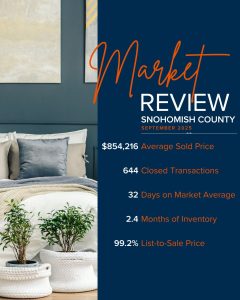
Ready to take a look at what changed in our real estate market in September 2025?

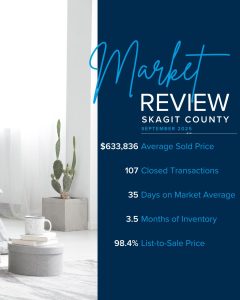
Learn more about Snohomish County by visiting HERE.
Why October Is the Best Time To Buy a Home in 2025

Why October Is the Best Time To Buy a Home in 2025

If you’ve been watching from the sidelines, now’s the time to lean in. It’s officially the best time to buy this year. According to Realtor.com, this October will have the most buyer-friendly conditions of any month in 2025:
“By mid-October, buyers across much of the country may finally find the combination of inventory, pricing, and negotiating power they’ve been waiting for—a rare opportunity in a market that has been tight for most of the past decade.”
So, if you’re ready and able to buy right now, shooting for this month means you should see:
- More homes to choose from
- Less competition from other buyers
- More time to browse
- Better home prices
- Sellers who are more willing to negotiate
For most of the top 50 largest metros, that sweet spot falls in October. But the peak time to buy may be slightly earlier or later, depending on where you live. As Realtor.com explains:
“While Oct. 12–18 is the national “Best Week,” timing can shift depending on the local markets. . .”
Best Week To Buy for the Top 50 Largest Metro Areas
- Atlanta-Sandy Springs-Roswell, GA: September 28 – October 4
- Austin-Round Rock-San Marcos, TX: September 28 – October 4
- Baltimore-Columbia-Towson, MD: October 12 – 18
- Birmingham, AL: October 19 – 25
- Boston-Cambridge-Newton, MA-NH: October 26 – November 1
- Buffalo-Cheektowaga, NY: October 12 – 18
- Charlotte-Concord-Gastonia, NC-SC: November 2 – 8
- Chicago-Naperville-Elgin, IL-IN: September 28 – October 4
- Cincinnati, OH-KY-IN: October 12 – 18
- Cleveland, OH: October 12 – 18
- Columbus, OH: October 12 – 18
- Dallas-Fort Worth-Arlington, TX: September 28 – October 4
- Denver-Aurora-Centennial, CO: October 12 – 18
- Detroit-Warren-Dearborn, MI: October 12 – 18
- Grand Rapids-Wyoming-Kentwood, MI: September 28 – October 4
- Hartford-West Hartford-East Hartford, CT: September 21 – 27
- Houston-Pasadena-The Woodlands, TX: October 12 – 18
- Indianapolis-Carmel-Greenwood, IN: October 26 – November 1
- Jacksonville, FL: October 26 – November 1
- Kansas City, MO-KS: October 12 – 18
- Las Vegas-Henderson-North Las Vegas, NV: October 5 – 11
- Los Angeles-Long Beach-Anaheim, CA: October 12 – 18
- Louisville/Jefferson County, KY-IN: November 2 – 8
- Memphis, TN-MS-AR: September 21 – 27
- Miami-Fort Lauderdale-West Palm Beach, FL: November 30 – December 6
- Milwaukee-Waukesha, WI: September 7 – 13
- Minneapolis-St. Paul-Bloomington, MN-WI: October 26 – November 1
- Nashville-Davidson–Murfreesboro–Franklin, TN: October 12 – 18
- New York-Newark-Jersey City, NY-NJ: September 14 – 20
- Oklahoma City, OK: October 12 – 18
- Orlando-Kissimmee-Sanford, FL: October 26 – November 1
- Philadelphia-Camden-Wilmington, PA-NJ-DE-MD: September 7 – 13
- Phoenix-Mesa-Chandler, AZ: November 2 – 8
- Pittsburgh, PA: October 12 – 18
- Portland-Vancouver-Hillsboro, OR-WA: October 26 – November 1
- Providence-Warwick, RI-MA: October 19 – 25
- Raleigh-Cary, NC: October 12 – 18
- Richmond, VA: October 26 – November 1
- Riverside-San Bernardino-Ontario, CA: September 28 – October 4
- Sacramento-Roseville-Folsom, CA: October 12 – 18
- San Antonio-New Braunfels, TX: October 12 – 18
- San Diego-Chula Vista-Carlsbad, CA: October 12 – 18
- San Francisco-Oakland-Fremont, CA: October 12 – 18
- San Jose-Sunnyvale-Santa Clara, CA: October 19 – 25
- Seattle-Tacoma-Bellevue, WA: October 19 – 25
- St. Louis, MO-IL: October 12 – 18
- Tampa-St. Petersburg-Clearwater, FL: November 30 – December 6
- Tucson, AZ: October 12 – 18
- Virginia Beach-Chesapeake-Norfolk, VA-NC: September 21 – 27
- Washington-Arlington-Alexandria, DC-VA-MD-WV: October 12 – 18
What the Experts Are Saying
And Realtor.com isn’t the only one saying you’ve got an opportunity if you move now. Lawrence Yun, Chief Economist at the National Association of Realtors (NAR), explains:
“Homebuyers are in the best position in more than five years to find the right home and negotiate for a better price. Current inventory is at its highest since May 2020, during the COVID lockdown.”
Daryl Fairweather, Chief Economist at Redfin, puts it like this:
“Nationally, now is a good time to buy, if you can afford it . . . with falling mortgage rates and significantly more inventory, buyers have an upper hand in negotiations.”
And NerdWallet says:
“This fall just might be the best window for home buyers in the past five years.”
How To Get Ready for this Golden Window
If you’re serious about buying, getting prepped for this October window is a smart play.
Want help lining up your strategy? Let’s have a quick conversation so you’ve got the information you need to be ready for this prime buying time.
